Dutch elm disease sanitation program in New York
Silent SpringThe Dutch elm disease sanitation program in New York is Rachel Carson’s counterexample to the assumption that community-wide spraying is the necessary answer to an invasive tree disease. By removing diseased elms and the wood in which elm bark beetles could breed, New York suppressed losses without recommending community spraying; its record shows how identifying and acting on the disease’s transmission pathway could protect trees while limiting the scope and cost of control.
The disease and the choice of method
Dutch elm disease was thought to have entered the United States through the Port of New York around 1930, in diseased elm wood. New York therefore faced the disease early and had a long history of continuous experience with it. Yet the state’s agricultural extension service did not recommend spraying as a community method. Instead, its control strategy centered on sanitation: promptly removing and destroying infected wood before it could give rise to beetles that spread the disease.
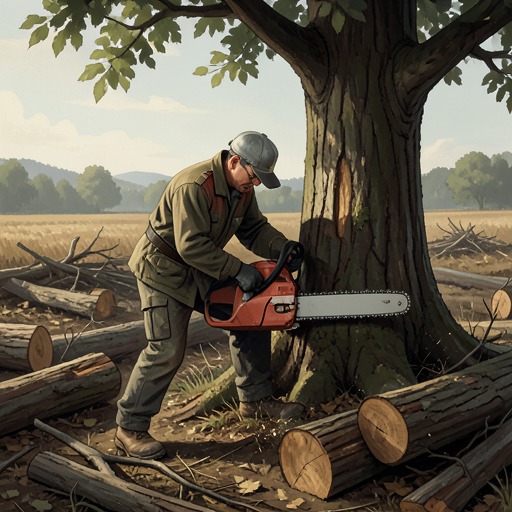
The method required understanding that the hazard was not confined to visibly diseased trees. Early results were disappointing because the program initially failed to recognize that all elm wood in which beetles might breed also had to be destroyed. Infected wood cut and stored for firewood remained a source of danger: unless burned before spring, it could release fungus-carrying beetles. The adult beetles emerged from hibernation and fed in late April and May, making the fate and timing of stored wood consequential to the disease’s spread.
Sanitation in practice
Once the program focused on beetle-breeding material as well as diseased trees, it could concentrate effort on the wood most relevant to transmission. That selectivity served both ecological and practical ends: New York obtained good results while keeping sanitation costs within reasonable limits. The program’s governing logic was not to treat every part of the community indiscriminately, but to remove the material through which the disease could continue to travel.
The results accumulated across several places rather than resting on a single success. By 1950, Dutch elm disease incidence in New York City had fallen to about 1 percent among the city’s 55,000 elms. Westchester County launched a sanitation program in 1942. In Buffalo, annual losses were also reported at only about 1 percent, a rate at which the city’s elms would take roughly 300 years to disappear if losses continued unchanged.
Syracuse and the effect of sustained removal
Syracuse offered a particularly clear before-and-after comparison. No effective program had been operating there before 1957, and nearly 3,000 elms were lost between 1951 and 1956. Under the direction of Howard C. Miller of the New York State University College of Forestry, an intensive campaign then removed diseased elm trees and all possible sources of beetle-breeding elm wood. Afterward, the annual rate of loss fell well below 1 percent.
The contrast makes the program’s central lesson concrete: removing infected trees alone was insufficient if breeding material remained available. Syracuse’s improvement followed a drive that addressed both parts of the problem. New York experts also stressed that prompt removal could be economical. In urban areas, dead trees generally had to be removed eventually, so removing them early to reduce disease spread often cost no more than waiting.
Limits and significance
The program did not promise eradication. Once Dutch elm disease had become established, it could not be eliminated by any means then known. The case instead demonstrates a more bounded objective: informed and intelligent measures could suppress its advance and reduce losses. That distinction matters because the record is one of continuing management, not a final victory over the disease.
In Carson’s account of pesticide control, New York’s experience challenges the idea that a large environmental problem must be met with broad chemical treatment. The state’s approach connected the disease to its means of transmission, then directed labor toward the infected trees and beetle-breeding wood that sustained it. Its city-by-city results make sanitation a practical alternative to spraying: targeted action could preserve a substantial share of the elms, contain costs, and avoid turning control itself into a new source of indiscriminate damage.